

Firearms History Resource
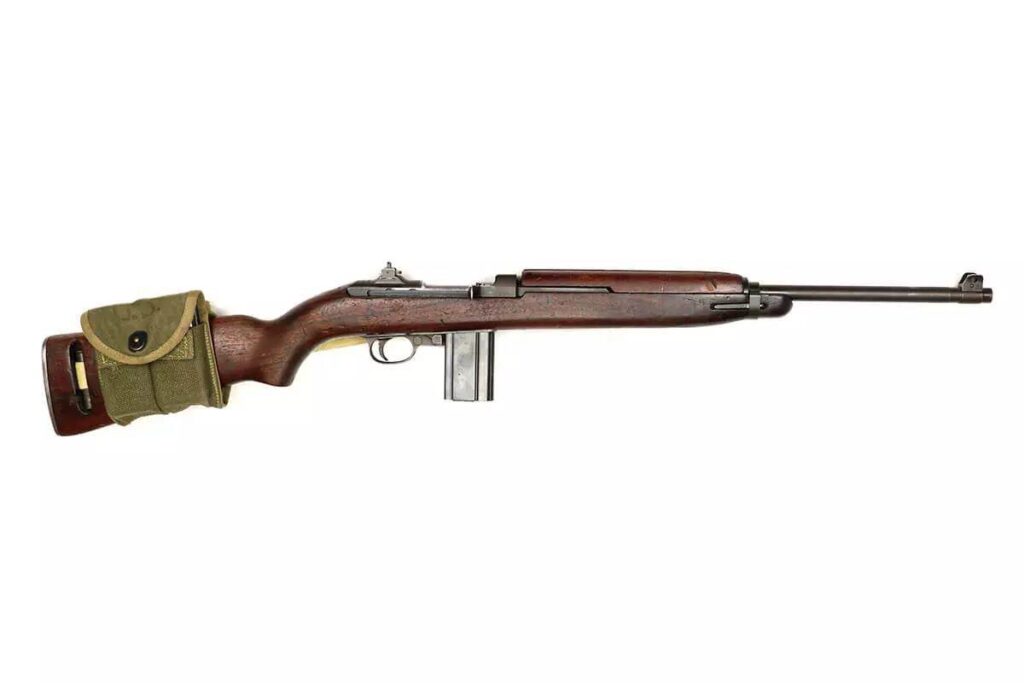
The M1 Carbine is one of the most-produced and best-loved American military firearms of the 20th century. Conceived as a light, handy weapon to replace the pistol for troops who didn’t need a full-size battle rifle, it was made in staggering numbers by a remarkable range of manufacturers and served across multiple wars. Its blend of history, variety, and shootability makes it a cornerstone of US martial arms collecting.
The M1 Carbine is a lightweight, gas-operated, semi-automatic rifle chambered in .30 Carbine (7.62×33mm). It uses a short-stroke gas piston system and feeds from a detachable magazine, typically 15 or 30 rounds. At around five and a half pounds, it was far lighter and handier than the M1 Garand, and it was intended for support troops, officers, paratroopers, and others who needed something more capable than a pistol but less burdensome than a full rifle. It was formally adopted in 1941.
The M1 Carbine is chambered in .30 Carbine (7.62×33mm), a compact cartridge that is much less powerful than the .30-06 used in the M1 Garand. This is a frequent point of confusion: despite both being “M1” and both being “.30,” the Carbine and the Garand fire completely different, non-interchangeable cartridges. The .30 Carbine round sits between a pistol and a full rifle cartridge in power, appropriate to the carbine’s light, handy role. .30 Carbine ammunition remains commercially available today.
This is one of the most interesting aspects of M1 Carbine collecting. Ten prime contractors produced M1 Carbines during World War II, many of them companies with no prior firearms experience, mobilized for the war effort. They included Inland (a division of General Motors, the largest producer), Winchester, Underwood (a typewriter maker), National Postal Meter, Standard Products, Saginaw (another GM division), IBM, Quality Hardware, Rock-Ola (the jukebox manufacturer), and Irwin-Pedersen. Because parts were sourced across a shared subcontractor network and rifles were rebuilt and arsenal-refurbished over the years, mixed-maker parts are extremely common and entirely correct. Collectors often seek specific makers, and the story of these diverse wartime manufacturers is a large part of the M1 Carbine’s charm.
Beyond the standard M1 Carbine, the family includes the M1A1 (with a folding stock for paratroopers), the M2 (a selective-fire version capable of automatic fire), and the M3 (an M2 fitted for early infrared night sights). Within the standard M1, features evolved over production and through arsenal rebuilds: early flip-style rear sights gave way to adjustable rear sights (milled or stamped), early barrel bands were replaced by types with a bayonet lug, and safety types changed from a push-button to a rotary lever. Stocks appear in “low wood” and “high wood” (often called M1 and M2 style) patterns, and upper handguards may be two-rivet or four-rivet. These details help collectors date and identify a given carbine.
For M1 Carbine buyers, bore condition is a key quality measure, and it’s often expressed as a gauge number. A muzzle or throat gauge measures wear in the bore; lower numbers indicate less wear and a better bore. When a surplus carbine is described as gauging, say, “1 to 2.5” or “hand-select 2.0 or less,” that’s a shorthand for how much life and accuracy potential remains in the barrel. A lower gauge reading generally means a crisper bore and better shooting, which is why hand-select options guaranteeing a low gauge command premium interest.
The M1 Carbine saw extensive service in World War II across every theater, then continued into the Korean War and beyond, serving with US and allied forces in numerous later conflicts. Millions were produced, and after the wars many were distributed to allied nations, refurbished, and stored, which is why surplus examples, including those returning from overseas storage, continue to reach collectors today.
Highly so. It offers genuine WWII and Korea history, an unusually rich variety of makers and variants to pursue, and real shootability with an available cartridge. The diversity of wartime manufacturers, the evolution of features, and the detective work of identifying a carbine’s configuration and history all make it a deeply rewarding collecting field. Original, correct-configuration examples and specific rare makers command premiums, while shooter-grade carbines remain accessible.
The M1 Carbine is a robust, well-proven design, and sound examples are excellent, practical shooters with correct .30 Carbine ammunition. As with any surplus firearm, a specific carbine should be inspected by a qualified gunsmith to confirm good mechanical condition and a sound bore before firing. Given its rugged design and a still-produced cartridge, a mechanically sound M1 Carbine is one of the most enjoyable US martial arms to shoot.
Name:
Type:
View
