

Firearms History Resource
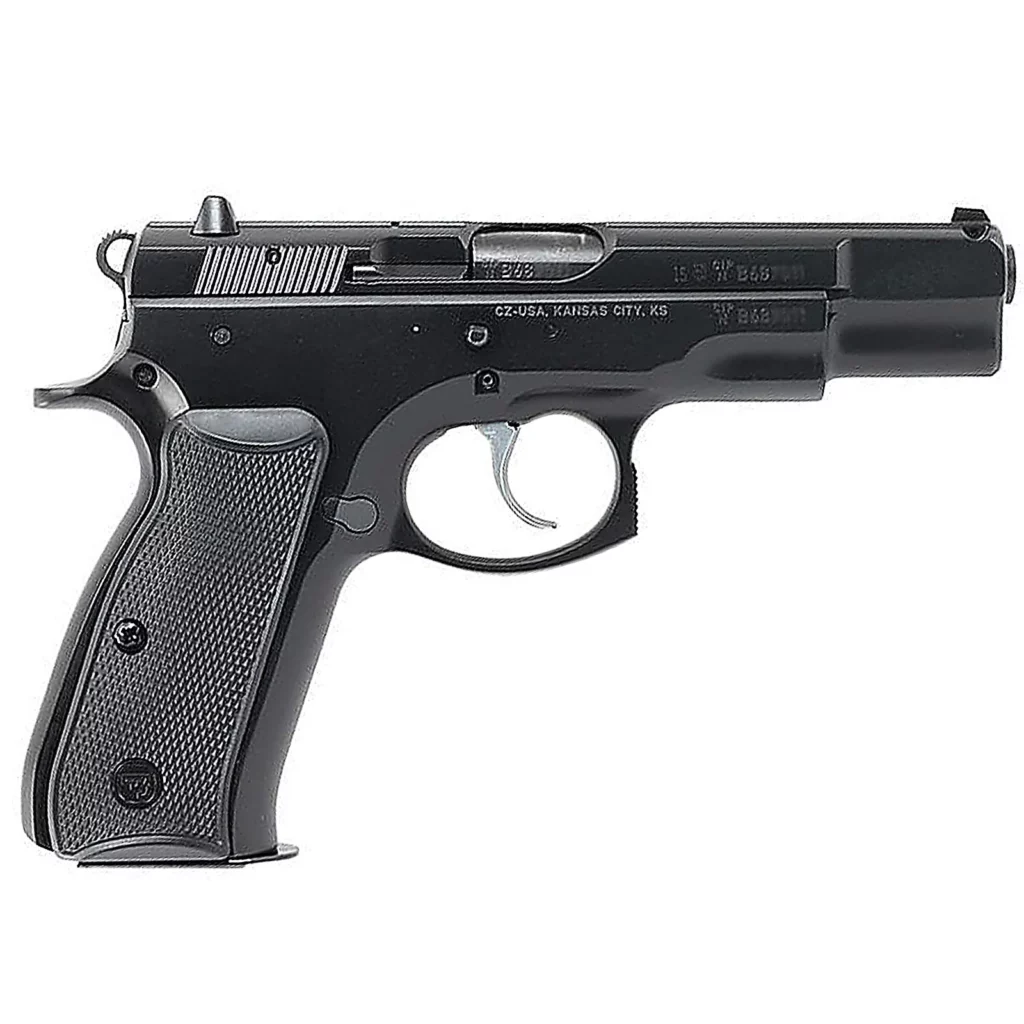
The CZ75 is widely considered one of the great service pistol designs of the 20th century. Developed in communist-era Czechoslovakia yet embraced worldwide, it combined features that were ahead of their time and has been copied by more manufacturers than almost any other handgun. For collectors and shooters alike, it’s a landmark pistol.
The CZ75 is a semi-automatic, short-recoil-operated pistol chambered in 9mm Luger (9×19mm). Designed by the brothers Josef and František Koucký and introduced by Česká Zbrojovka (CZ) in 1975, it features a double-action/single-action trigger and a high-capacity double-stack magazine, which was relatively uncommon and advanced for a service pistol of its era. Its most distinctive engineering feature is that the slide rides inside the frame rails rather than outside them, giving a low bore axis and a notably comfortable, controllable feel that shooters have praised for decades.
Several features came together to make the CZ75 exceptional. The slide-in-frame design lowers the bore axis and improves the grip-to-hand relationship, aiding control and accuracy. The ergonomics are widely considered among the best of any service pistol, the grip angle and shape suit a wide range of hands. The double-stack magazine gave high capacity when many rivals were still single-stack. And the overall build quality and reliability earned it a strong reputation. So respected was the design that it became one of the most cloned pistols in history, with numerous manufacturers worldwide producing CZ75-pattern handguns.
The CZ75 has appeared in many variants over the decades. The original and many early models use a frame-mounted safety, allowing “cocked and locked” carry. The CZ75 BD (“B Decocker”) replaces that safety with a decocker, a lever that safely lowers the hammer on a loaded chamber. The BD also incorporates the improvements of the CZ75 B generation, such as a firing pin block (loaded chamber safety), plus refinements like additional front and rear strap checkering. In short: the standard CZ75 typically has a manual safety; the BD has a decocker and the later B-series safety features.
The CZ85 is a variant of the CZ75 that adds ambidextrous controls, mirrored safety and slide-release levers for left-handed shooters, along with upgraded sights and a few other refinements. Mechanically it shares the CZ75’s core action and reputation for quality. Collectors and shooters often treat the CZ85 as the ambidextrous sibling of the CZ75, and the two are closely related within the same family.
The CZ75 is chambered in 9mm Luger (9×19mm), one of the most common and widely available handgun cartridges in the world. This makes the CZ75 and its variants entirely practical to shoot, ammunition is inexpensive and everywhere, which is part of why the platform remains popular for range use, competition, and carry decades after its introduction.
Yes, on two fronts. As a shooter’s pistol, it remains one of the most respected 9mm service handgun platforms in the world, with an enthusiastic following. As a collectible, early examples, particularly early blued-finish CZ75s from the pistol’s first years, are of interest for their place in the design’s history, and specific variants and finishes attract collector attention. Its status as one of the most influential and copied pistol designs ever made adds to its appeal. Surplus and used examples, including those with police-agency history, are widely available.
The CZ75 is a modern, robust service pistol, and sound examples are excellent, practical shooters with standard 9mm Luger ammunition. As with any used firearm, a specific pistol should be inspected to confirm it’s in good mechanical order before use, but this is a current, mainstream design rather than an antique, and it’s one of the most shootable and enjoyable pistols in its class. Details like hammer style and grips may vary between individual examples, which is normal for a design produced over many years.
Name:
Type:
View
