

Firearms History Resource
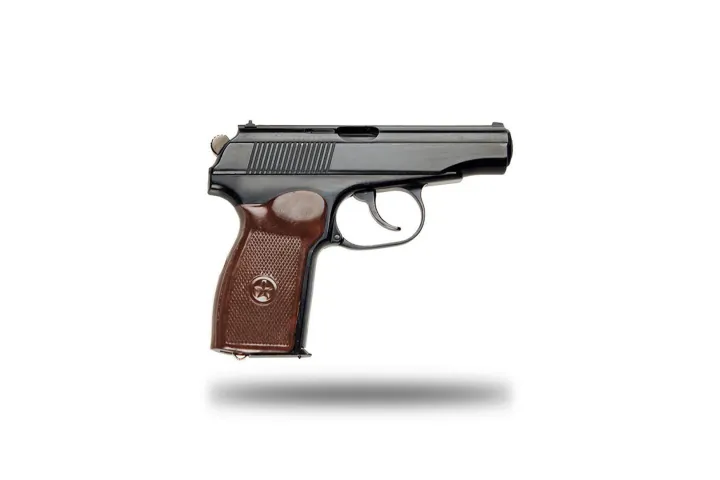
The Makarov PM (Pistolet Makarova) was the standard sidearm of the Soviet Union and much of the Warsaw Pact for decades. Simple, robust, and reliable, it’s one of the most widely produced military pistols of the Cold War and a favorite among collectors for its build quality, historical significance, and shootability.
The Makarov is a compact, blowback-operated semi-automatic pistol chambered in 9×18mm Makarov. Designed by Nikolai Makarov, it was adopted by the Soviet Union in 1951 to replace the TT-33 Tokarev. Like other successful blowback pistols, it has no locking mechanism, the slide’s mass and the recoil spring contain the cartridge, which keeps the design simple and durable. It uses a double-action/single-action trigger, an 8-round single-stack magazine, and fixed sights, and it is famous for having relatively few parts, contributing to its legendary reliability.
The 9×18mm Makarov is a distinct cartridge, not interchangeable with 9mm Luger (9×19mm) or .380 ACP, and this is an important point for owners. Although called “9mm,” the Makarov round actually uses a slightly larger bullet diameter (around 9.2mm) than Western 9mm cartridges. It was deliberately designed as the most powerful cartridge that could be safely used in a simple blowback (unlocked) action, balancing effectiveness against the mechanical simplicity the Soviets wanted. Always use the correct 9×18mm Makarov ammunition; the other “9mm” rounds are not compatible.
The Makarov was produced across the Eastern Bloc. The Soviet Union (later Russia) made them at Izhevsk; East Germany, China (as the Type 59), and Bulgaria also produced them. Bulgarian Makarovs, identified by the “Circle 10” arsenal mark (a “10” inside a circle, the mark of the Arsenal factory in Kazanlak), are particularly well regarded by collectors for their build quality and finish. Each country’s production carries distinct markings that collectors use to identify origin.
The Circle 10 mark, a numeral 10 enclosed in a circle, identifies a Bulgarian Makarov produced by the Arsenal (Arsenal AD) factory. Bulgarian production is prized for its consistent quality, and Circle 10 examples are among the more sought-after standard Makarovs. Collectors look for this mark, along with matching serial numbers on the slide and frame, as indicators of an original, correctly assembled pistol.
Yes. The Makarov combines genuine Cold War history, excellent build quality, wide variety across producing nations, and real shootability into an affordable and compact package. Unissued surplus examples, often arriving with their original holster, spare magazine, and storage box, are especially appealing as a complete historical package. Matching numbers, arsenal marks, and country of origin all factor into collector interest, and the Bulgarian and East German examples are frequently the most desired.
The Makarov is a modern, robust design, and sound examples are very shootable with correct 9×18mm Makarov ammunition. As with any surplus firearm, have a specific pistol inspected by a qualified gunsmith before firing to confirm mechanical condition. Because it’s a Cold War-era rather than a century-old design, and uses a still-produced cartridge, a sound Makarov is one of the more practical and enjoyable military surplus pistols to shoot, provided you feed it the correct 9×18mm round.
Name:
Type:
View
