

Firearms History Resource
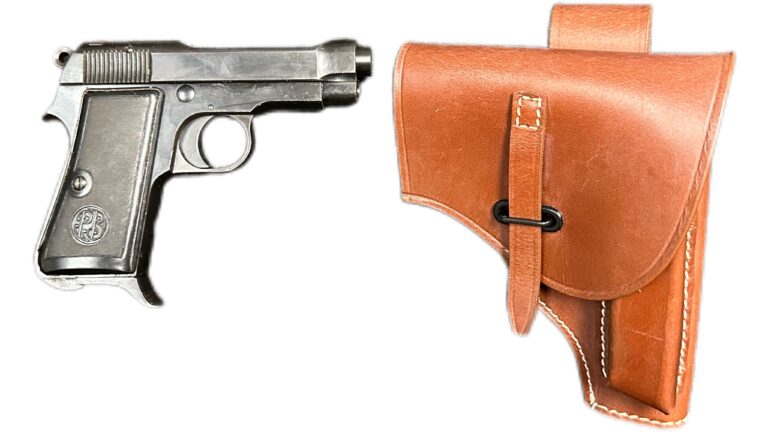
The Beretta Modello 1934 is one of the most recognizable service pistols of World War II and a landmark in Beretta’s long history of compact automatics. Simple, rugged, and distinctly styled, it was the standard sidearm of the Italian armed forces and remains a popular collectible today.
The M1934 is a compact, single-action, blowback-operated semi-automatic pistol chambered in .380 ACP (9mm Corto/Kurz). “Blowback” means it has no locking mechanism; the weight of the slide and the recoil spring alone contain the cartridge, which is practical in a relatively low-pressure round like the .380. It feeds from a single-stack detachable magazine and is built almost entirely of steel, giving it a solid, durable feel that owners often describe as “old school.” Its open-top slide, exposed hammer, and distinctive curved grip make it easy to recognize.
The M1934 was adopted as the standard sidearm of the Italian military in 1934 and was issued across the Italian Army, Navy, and Air Force through World War II. It armed Italian officers and personnel throughout the conflict and continued in service and circulation for years afterward. Its widespread issue and long production run mean many survive today, often with markings that identify the branch or era of issue.
The M1934 and M1935 are essentially the same pistol in different calibers. The M1934 is chambered in .380 ACP (9mm Corto), while the M1935 is chambered in .32 ACP (7.65mm Browning). The .380 M1934 was the primary military-issue pistol, while the .32 M1935 was often issued to the Navy, Air Force, and other services. Mechanically and visually they are near-identical; the caliber is the defining difference. Collectors frequently cross-shop the two, and a holster or accessory for one typically fits the other.
The M1934’s appeal lies in its simplicity and build quality. The blowback action has few parts and is easy to maintain and reliable. The all-steel construction feels substantial and has proven durable over decades. And the design has a certain elegance, Beretta’s characteristic open-slide styling that would carry through to later, more famous Beretta pistols. For collectors, it offers genuine WWII history in a compact, shootable, well-made package.
The M1934 uses .380 ACP, also called 9mm Corto or 9mm Kurz, a common and widely available cartridge still in regular production today. This is one of the M1934’s practical advantages as a collectible: unlike many obsolete-caliber milsurp arms, ammunition for a sound M1934 is easy to find. (The M1935 sibling uses the equally available .32 ACP / 7.65mm Browning.)
M1934 pistols carry a range of markings that help identify their history, including Italian military acceptance marks, branch markings, and date codes, and some examples carry markings from other nations that used them. Frames and slides may show serial numbers, and certain contract or captured examples carry additional stamps. Because the pistol was made over a long span and issued broadly, these details are part of what makes collecting them interesting. Barrel and configuration details also matter: original-configuration examples are treated differently from those with later modifications such as threaded or replacement barrels.
The M1934 is a robust design, and many sound examples are shootable with appropriate .380 ACP ammunition. As with any decades-old firearm, a specific pistol should be inspected by a qualified gunsmith before firing, checking the bore, springs, and overall mechanical condition. Given its durable all-steel construction and a common, currently produced cartridge, a mechanically sound M1934 is among the more practical WWII-era pistols to actually shoot, once that inspection confirms it’s in good order.
Name:
Type:
View
