

Firearms History Resource
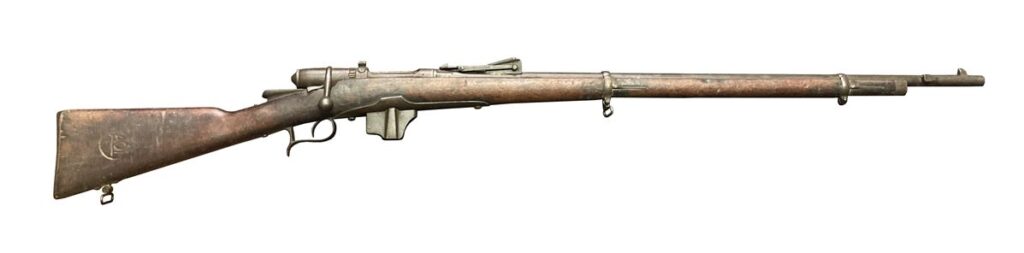
The Italian Vetterli is really several rifles in one lineage, evolving over roughly fifty years from a single-shot blackpowder rifle into a magazine repeater and, for some examples, a WWI-era cartridge conversion. Because these stages differ significantly, and because one of them carries real safety concerns, it’s worth understanding each clearly.
The design traces to the Swiss Vetterli, developed by Friedrich Vetterli, which was an advanced repeating rifle for its time. Italy adopted a simplified, single-shot version of the concept as its Model 1870, chambered in the 10.4×47R (10.35 Vetterli) centerfire cartridge. Unlike the Swiss original, which was a magazine repeater, the Italian M1870 was built as a single-shot rifle, simplified for economy. It was at first a blackpowder cartridge, later loaded with smokeless powder, and it served as Italy’s standard infantry rifle from 1870.
Beginning in 1887, Italy began converting the single-shot M1870 into a repeating rifle using a box magazine system designed by artillery captain Giuseppe Vitali. This conversion added a magazine fed by a fabricated steel-and-wood clip holding four cartridges, in the same 10.4×47R caliber as before. The clip is pressed into the magazine until the cartridges are retained, then withdrawn using a pull-string in the top of the clip frame. The result was the Model 1870/87 Vetterli-Vitali, a four-shot repeater. This conversion was carried out on the long rifle and certain other variants, and it identifies these rifles as the Vitali magazine version rather than the earlier single-shot.
This is the most important distinction for anyone handling a Vetterli. During World War I, as Italy faced small-arms shortages, many 1870/87 rifles were converted again, this time rechambered to fire the standard 6.5mm Carcano smokeless cartridge, becoming the Model 1870/87/15. The conversion sleeved the barrel to 6.5mm (a method sometimes called the “Salerno” sleeve), modified the bolt face for the smaller cartridge head, and adapted the magazine.
Here is the critical point: these 6.5 Carcano conversions are widely regarded by knowledgeable collectors as unsuitable for firing. The rifles were designed in the 1870s around a blackpowder cartridge, converted twice, and the 6.5mm smokeless round generates pressures the original action was never built for. The soft-soldered Salerno barrel sleeve is prone to loosening under fire, and blow-by and safety issues have been documented since these appeared as surplus. In their own time they were issued largely to rear-echelon and colonial troops and were rarely fired. Anyone encountering a 1870/87/15 should treat it accordingly and not assume it is a shooter.
Two cartridges matter. The original and Vitali-converted rifles use 10.4×47R (10.35 Vetterli), an obsolete blackpowder-era cartridge available from specialty makers and handloadable. The 1870/87/15 conversions are chambered in 6.5 Carcano. Confusing the two, or assuming any Vetterli is a shooter, is exactly the mistake to avoid: identify which rifle you have before anything else.
The Vetterli was Italy’s standard service rifle in the late 19th century until superseded by the Carcano in the 1890s. The old rifles didn’t disappear, though. Large numbers of obsolete Vetterli-Vitali rifles were pressed back into service during World War I for newly formed and reserve units, and some were carried into combat despite their age. Italy also shipped many to Russia in 1916; some of those eventually reached the Spanish Civil War as old stocks were emptied. Many surviving examples spent decades in colonial storage, including in Ethiopia, which is a common source of surplus reaching collectors today. Some of these show field modifications, such as removed rear sights attributed to cavalry units.
Yes. The Vetterli offers a rich, multi-stage history: a Swiss-derived design, an early Italian single-shot, an ingenious Vitali magazine conversion, and a controversial WWI cartridge conversion, all in one lineage. Original markings, cartouches (such as the “Artig. Fab. D’Armi Terni” repair marks), and the specific variant make each rifle a small puzzle to identify. Condition varies widely, and many are affordable given their age. The historical depth is a large part of the appeal.
This depends entirely on which Vetterli it is, and the answer skews cautious across the board. The 6.5 Carcano 1870/87/15 conversions should not be relied upon as shooters for the reasons above, they are best treated as collector pieces. The original 10.4×47R rifles and Vitali conversions are very old blackpowder-era arms; if firing is even considered, the rifle must first be thoroughly inspected by a qualified gunsmith, with bore, breech, and mechanical condition verified. Given their age, many Vetterlis of any type are best regarded as collectibles rather than shooters. When in doubt, do not fire, and consult a professional.
Name:
Type:
View
