

Firearms History Resource
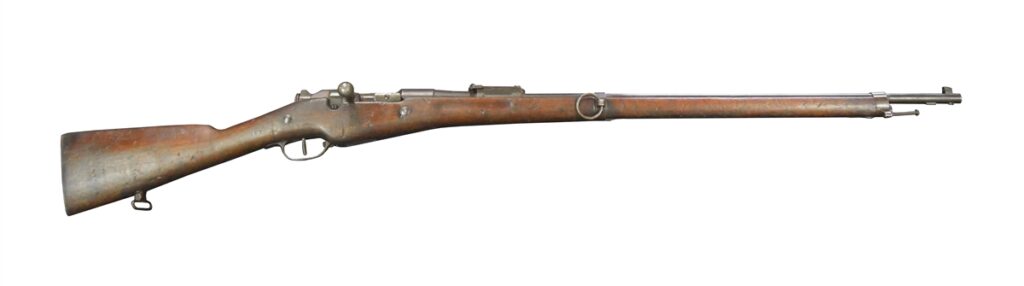
The Berthier is best understood as France’s answer to a problem created by its own revolutionary Lebel: the Lebel’s tube magazine was slow to load. Designed by Émile Berthier, the Berthier system kept the same 8mm Lebel cartridge but fed it from a faster en-bloc clip, and it went on to serve France in an enormous variety of rifles and carbines across both World Wars.
The Berthier is a bolt-action rifle and carbine family chambered in 8mm Lebel. Its defining feature is the feeding system: rather than the Lebel’s tubular magazine, the Berthier uses an en-bloc clip loaded into a box magazine, the same principle as the Mannlicher and Carcano systems, where the clip is inserted with the cartridges and drops free once the last round is chambered. This made the Berthier significantly faster to reload than the Lebel while using the identical cartridge.
The Lebel Mle 1886 was revolutionary for its smokeless cartridge, but its under-barrel tube magazine was slow to load, awkward to top up, and shifted the rifle’s balance as it emptied. For cavalry, artillery, and colonial troops who needed a handier, faster-loading arm, France developed the Berthier as a carbine first, then expanded it into full-length rifles. The two systems served side by side, firing the same 8mm Lebel round but feeding it differently. This is the key relationship to understand: Lebel and Berthier are complementary French service arms, not rivals.
The Berthier family is large. The early carbines (such as the Mle 1890 cavalry carbine and Mle 1892 artillery carbine) came first, using a 3-round en-bloc clip. Full-length rifles followed, most notably the Fusil Mle 1907 and the widely produced Mle 1907/15, a simplified wartime rifle built in large numbers during World War I. Later, the Mle 1916 rifles and carbines introduced an improved 5-round clip and an upper handguard, addressing the smaller capacity and other lessons of wartime use. Collectors distinguish these by clip capacity, length, sight and handguard details, and markings.
The Mle 1907/15 is among the most commonly encountered Berthiers. It was a wartime-simplified version of the Mle 1907 rifle, produced in quantity to meet the enormous demand of World War I. It uses the 3-round en-bloc clip and was a standard French infantry rifle of the war. Many 1907/15 rifles saw long service lives and later export, and they are frequently found among surplus today.
The Berthier is chambered in 8mm Lebel (8×50mmR), the same smokeless cartridge as the Lebel rifle. The difference between the two systems is entirely in the feeding, not the ammunition. 8mm Lebel is obsolete but available from specialty makers and can be handloaded.
The Berthier was a primary French infantry and cavalry arm throughout World War I and continued in service, in various updated and reserve forms, into World War II. It also saw extensive colonial use and later appeared in conflicts such as the Spanish Civil War as surplus arms circulated. Its long, broad service across French metropolitan and colonial forces makes it one of the most historically well-traveled rifles of its era.
Yes. The Berthier offers genuine two-World-War history, an unusually wide range of variants to collect (carbines, rifles, multiple patterns, and clip capacities), and a direct connection to the story of the Lebel and the smokeless-powder revolution. Matching-numbers examples and specific patterns command more interest, and the variety within the family gives collectors a lot to pursue. Surplus examples remain reasonably available.
As with any century-old military rifle, a Berthier should be inspected by a qualified gunsmith before firing, with bore, headspace, and overall mechanical condition verified. It requires the correct 3-round or 5-round en-bloc clip to function as a repeater. With a sound rifle, the right clips, and appropriate 8mm Lebel ammunition, some collectors do shoot them, but that professional inspection should always come first.
Name:
Type:
View
