

Firearms History Resource
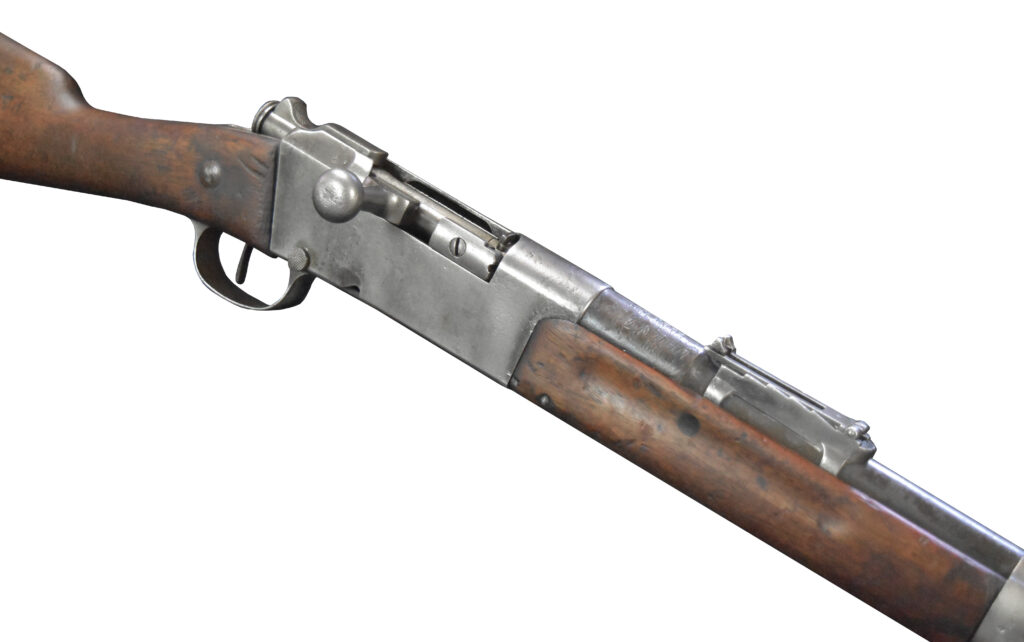
The Fusil Mle 1886, universally known as the Lebel, is one of the most historically important rifles ever fielded. Its introduction of a smokeless-powder cartridge triggered a worldwide arms race and made every existing military rifle instantly obsolete. Understanding the Lebel means understanding a genuine turning point in firearms history.
The Lebel was the first military rifle in the world chambered for a smokeless-powder cartridge. Smokeless powder, developed in France by Paul Vieille, produced far more energy than blackpowder while generating almost no smoke and far less fouling. This allowed a smaller, faster, flatter-shooting bullet, the 8mm Lebel, with dramatically better range and performance. The effect was seismic: overnight, every blackpowder military rifle in the world, including France’s own Gras that immediately preceded it, was rendered obsolete, and every major power scrambled to develop its own smokeless rifle and cartridge. The Lebel didn’t just modernize the French army; it forced the modernization of every army.
The Lebel is a bolt-action rifle chambered in 8mm Lebel (8×50mmR). It feeds from an 8-round tubular magazine housed beneath the barrel, a design inherited from the era’s thinking about repeating rifles. It was based partly on the earlier Gras action, adapted to a repeating configuration and the new smokeless cartridge. The rifle was long and used a two-piece system with the tube magazine, a plus one in the carrier and one in the chamber giving it a substantial ready capacity for its day.
The tube magazine, while giving good capacity, carried real disadvantages that later designs abandoned. Cartridges sit nose-to-primer in the tube, which required careful design of the 8mm Lebel bullet to avoid the risk of a pointed bullet’s tip resting on the primer of the round ahead of it. It was also slow to load, cartridges are fed in one at a time, and the rifle’s balance shifted as the tube emptied. These limitations are why the Lebel’s tube magazine was something of a technological dead end even as its cartridge and smokeless propellant were revolutionary. France itself moved toward the clip-fed Berthier system for many later rifles and carbines.
The Lebel is chambered in 8mm Lebel, also written 8×50mmR. This was the world’s first smokeless military cartridge. It is a rimmed round, and its distinctive heavily tapered case reflects its blackpowder-cartridge ancestry adapted to smokeless powder. 8mm Lebel is obsolete today but remains available from specialty manufacturers and can be handloaded.
The Lebel and Berthier served alongside one another in French service. The Lebel’s tube magazine was slow to load, so France adopted the Berthier system, using a faster en-bloc clip in a box magazine, for many carbines and later rifles while retaining the same 8mm Lebel cartridge. The two are best understood as complementary French service arms of the same era rather than direct competitors, both firing 8mm Lebel, but with different feeding systems.
Yes. Despite being introduced in 1886, the Lebel was still a frontline French infantry rifle in World War I, and modernized and reserve examples saw further use into World War II. Over its long service life it was updated in various patterns. Its longevity, spanning from the blackpowder-to-smokeless transition all the way through the World Wars, is part of what makes it such a significant collectible.
Very much so. Few rifles can claim to have changed the course of firearms history the way the Lebel did as the first smokeless military rifle. That significance, combined with its long service through both World Wars and its distinctive design, makes it a centerpiece for many collections. Condition and pattern vary, and its historical importance often outweighs its relative scarcity in driving collector interest.
As with any rifle well over a century old, a Lebel must be inspected by a qualified gunsmith before any attempt at firing, with bore, breech, and overall condition verified. With a mechanically sound example and appropriate 8mm Lebel ammunition, some collectors do shoot them, but the rifle’s age and the specifics of the tube magazine and cartridge make professional inspection essential first. When in doubt, treat it as the historical artifact it is.
Name:
Type:
View
