

Firearms History Resource
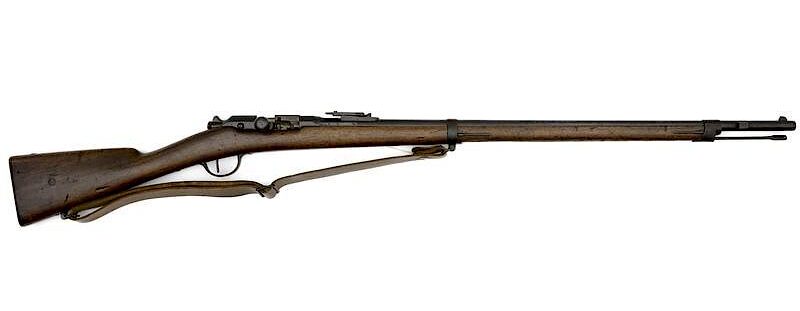
The Fusil Gras Mle 1874 holds an important place in firearms history as one of the first widely issued French rifles to fire a self-contained metallic cartridge. It emerged directly from the earlier Chassepot needle rifle, and understanding the Gras means understanding that lineage.
The story begins with the Chassepot, officially the Fusil Modèle 1866, a bolt-action breechloader that used a self-contained paper cartridge ignited by a needle-fire mechanism. Famous as the arm of French forces in the Franco-Prussian War of 1870-1871, the Chassepot was a major advance over the muzzleloaders and converted breechloaders that preceded it, and it marked the beginning of the modern era of bolt-action, breech-loading military rifles.
Its weakness was the paper cartridge and the perishable rubber obturator seal at the breech. In 1874, Captain Basile Gras designed a conversion that allowed the Chassepot action to fire a metallic cartridge, a step that solved the sealing problem and modernized the rifle. Rifles converted from Chassepots, and new-production rifles built to the same pattern, became the Fusil Gras Mle 1874.
The Gras is a single-shot, bolt-action rifle chambered in 11mm Gras (11×59mmR), a large blackpowder cartridge. It is loaded one round at a time through the open bolt. Mechanically it retains the Chassepot’s basic bolt-action layout, updated with a metallic-cartridge bolt head, extractor, and ejector. It served as the standard French infantry rifle until the arrival of the smokeless-powder, magazine-fed Lebel in 1886, after which the Gras was gradually relegated to reserve, colonial, and secondary use, though many soldiered on far longer.
The Gras family followed the standard French pattern of a full-length infantry rifle plus shorter versions for other troops:
The Fusil Mle 1874 is the full-length infantry rifle. The Mousqueton and carbine variants are shorter arms issued to cavalry, artillery, and other troops who needed a more compact weapon. Cavalry carbines in particular are shorter and handier, intended for mounted use. There are also rifles marked as 1866-74 conversions, these are original Chassepots converted to the Gras metallic-cartridge system, as distinct from receivers manufactured new as Mle 1874. Collectors distinguish between true 1874-marked receivers and the 1866-74 Chassepot conversions, and a given batch may contain both.
The Gras is chambered in 11mm Gras, also written 11×59mmR. It is a large-caliber, rimmed, blackpowder-era cartridge. While obsolete, it is available from specialty ammunition makers and can be handloaded, though these rifles are very old and any shooting should follow careful inspection.
The Gras represents a key transitional moment: the shift from needle-fire paper cartridges to self-contained metallic cartridges in a major military service rifle. It bridges the gap between the Chassepot generation and the smokeless-powder, repeating rifles that followed with the Lebel. That transitional significance, combined with the direct Chassepot connection, makes the Gras historically important beyond its service record.
Yes. The Gras carries genuine 19th-century French military history, a direct link to the famous Chassepot, and real variety across infantry rifles, carbines, cavalry versions, and Chassepot-conversion examples. Many surviving rifles saw long colonial service and later storage abroad, and they remain relatively affordable given their age and significance. Condition varies widely, from complete, functional examples down to parts-grade rifles suited to restoration projects.
These rifles are typically 130 to 150 years old, so mechanical condition varies enormously. Any Gras considered for firing must first be thoroughly inspected by a qualified gunsmith, checking bore, breech, and overall integrity. Many surviving examples are best regarded as collectible or restoration pieces rather than shooters, and parts-grade rifles with damaged bores or missing components should not be fired at all. When in doubt, treat the rifle as a collectible and consult a professional.
Name:
Type:
View
