

Firearms History Resource
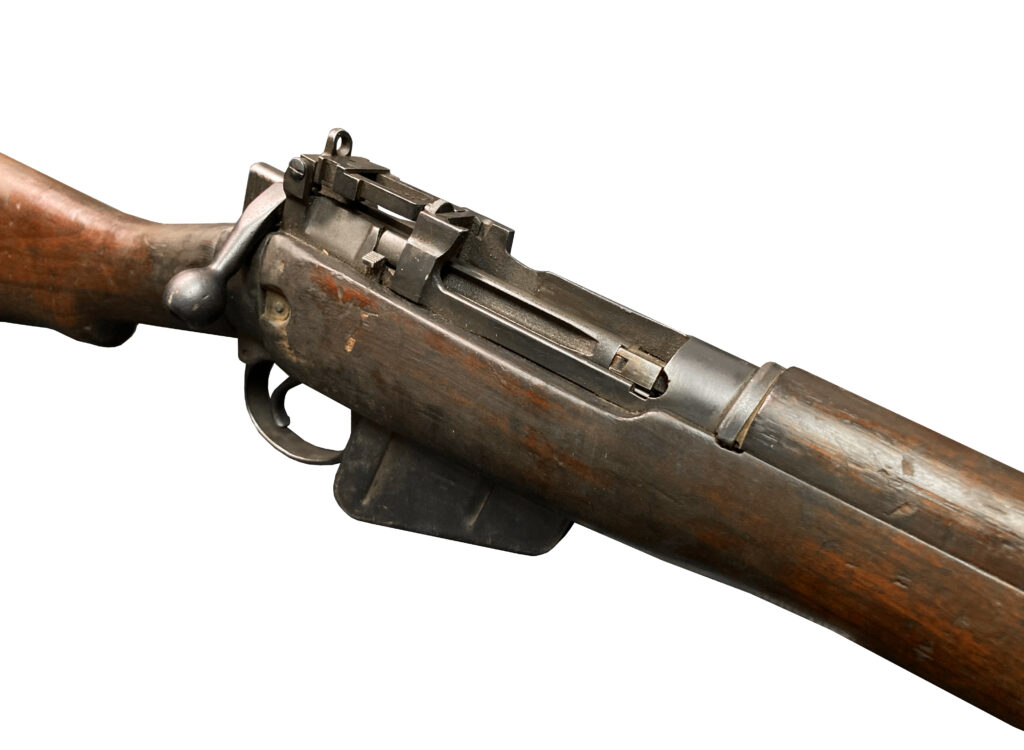
The Lee-Enfield No.4 Mk I was Britain’s principal service rifle of the Second World War, the culmination of decades of refinement to the Lee-Enfield design. Developed to be stronger and far easier to mass-produce than the SMLE No.1 Mk III it replaced, it went on to serve British and Commonwealth forces through WWII, Korea, and numerous later conflicts.
The No.4 Mk I is a bolt-action, magazine-fed rifle chambered in .303 British, feeding from the same 10-round detachable box magazine as its predecessors. It retains the fast cock-on-closing action and rear-locking bolt that made the Lee-Enfield famous, but with a heavier, more rigid receiver and a heavier barrel that improved both durability and accuracy. It was formally adopted in 1941, though development and limited production preceded that.
The No.4 was a deliberate redesign for wartime production and improved performance. The most visible difference is the muzzle: the No.4’s barrel protrudes past the forend, where the No.1 Mk III’s barrel is fully enclosed by the woodwork with a distinctive nose cap. Internally, the No.4 has a stronger receiver and a heavier barrel, contributing to better accuracy. It also replaced the No.1’s barrel-mounted rear sight with a receiver-mounted aperture (peep) sight set further back, giving a longer sight radius and easier, more precise aiming. Finally, the No.4 was engineered with more machine-friendly manufacturing in mind, critical for wartime output.
The No.4 introduced a rear aperture sight mounted at the back of the receiver. Aperture (peep) sights are faster and more precise than open notch sights because the eye naturally centers the front post in the rear aperture. Positioned close to the shooter’s eye with a long sight radius, this arrangement gave the No.4 a genuine accuracy advantage over the No.1 Mk III and is one reason the rifle was well regarded by marksmen.
Several variants exist. The No.4 Mk I and slightly revised No.4 Mk I* (a simplified bolt-release version produced largely in North America by Long Branch in Canada and Savage in the US) are the most common. The No.4 Mk 2, produced post-war, featured an improved trigger hung from the receiver rather than the trigger guard. A dedicated sniper variant, the No.4 Mk I (T), was fitted with a telescopic sight and cheek rest and is highly sought by collectors. Rifles were made across multiple factories, each with distinctive markings.
Like all the classic Lee-Enfields, the No.4 is chambered in .303 British. This rimmed cartridge remains commercially available and also circulates as surplus, so a sound No.4 is one of the more practical vintage military rifles to actually shoot.
Yes, strongly so. It carries genuine WWII and Cold War history, has meaningful variety across sub-variants and manufacturing countries (Britain, Canada, and the US among them), and the sniper (T) versions in particular are prized. Because it was produced in large numbers, standard examples remain affordable relative to their history, while rarer variants command a premium. Its reputation for accuracy also makes it popular with vintage-rifle shooters and competitors.
As with any surplus military rifle, have the rifle inspected by a qualified gunsmith before firing, verifying headspace, bore condition, and bolt-head fit. Lee-Enfields use numbered, replaceable bolt heads to set headspace, so that is a specific point to check. With a mechanically sound rifle, correct headspace, and appropriate .303 British ammunition, the No.4 Mk I is an accurate and rewarding rifle to shoot, once that inspection is done.
Name:
Type:
View
