

Firearms History Resource
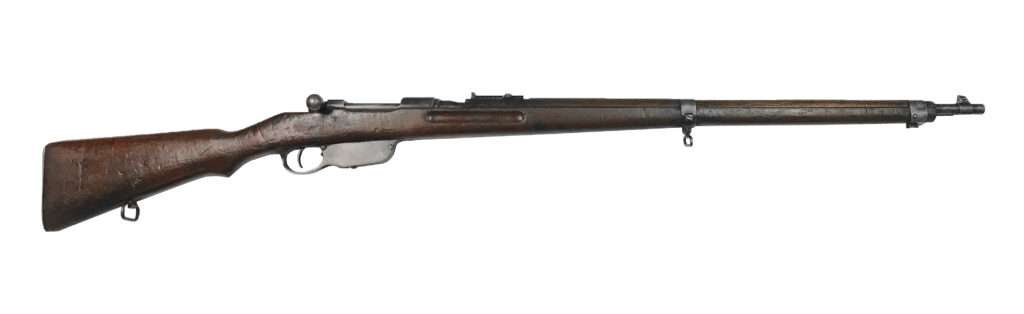
The Steyr M95, sometimes called the Steyr-Mannlicher M1895, is one of the most distinctive military rifles of the early 20th century. Designed by Ferdinand Ritter von Mannlicher and produced at the Steyr works in Austria and the Budapest arsenal in Hungary, it armed the Austro-Hungarian Empire through the First World War and went on to see decades of further service across Europe and beyond.
The M95 is a straight-pull bolt-action rifle, meaning the bolt is worked by pulling straight back and pushing straight forward rather than the lift-turn-pull-push motion of a traditional turn-bolt like the Mauser. This design allows a trained soldier to cycle the action and fire faster than most contemporary rifles. It feeds from a fixed magazine loaded with a 5-round en-bloc clip, a Mannlicher hallmark, where the entire clip is inserted with the cartridges and ejects out the bottom once the last round is chambered.
Originally, the M95 was chambered in 8×50R Mannlicher, a rimmed blackpowder-era cartridge later loaded with smokeless powder. In the 1930s, many rifles were rebarreled or rechambered to the more powerful 8×56R cartridge and marked with a letter “S” or “H” on the barrel and receiver. These converted rifles are known as the M95/34 (Austrian) or 31.M (Hungarian). This distinction matters enormously to a shooter: an original 8×50R rifle must never be fired with 8×56R ammunition, and vice versa. Always confirm the chambering by the markings before selecting ammunition.
The straight-pull system was Austria-Hungary’s answer to increasing the rate of aimed fire. Where a Mauser or Mosin-Nagant requires the shooter to rotate the bolt handle up, draw it back, push it forward, and rotate down, the M95’s bolt locks and unlocks through a rotating bolt head driven by a helical cam as the shooter simply pulls and pushes. In practice this made the M95 one of the faster-cycling bolt actions of its era. The tradeoff is that the action is more sensitive to dirt and fouling than a turn-bolt, which is part of why straight-pulls never fully displaced the Mauser pattern worldwide.
The M95 was the standard infantry rifle of the Austro-Hungarian Empire throughout World War I. After the empire’s dissolution, the rifles were distributed among successor and neighboring states, including Austria, Hungary, Italy (as war reparations), Yugoslavia, and Bulgaria. Many saw service again in World War II, and surplus examples continued to circulate for decades afterward. A large number ultimately ended up in storage in Ethiopia, which is the source of much of the surplus reaching collectors today, and these saw use during the Italo-Ethiopian conflict.
For collectors, the M95 offers a lot of history at a modest price. It’s mechanically interesting as one of the few mass-issued straight-pull military rifles, it has genuine WWI and WWII provenance, and both Steyr and Budapest production examples are available. Rifle-length and carbine-length (Stutzen) versions exist, giving collectors variety. Because so many survived, prices remain accessible compared to other WWI-era service rifles, making the M95 an excellent entry point into militaria collecting.
Any surplus rifle over a century old should be inspected by a qualified gunsmith before firing. Headspace, bore condition, and the mechanical integrity of the bolt should all be verified by a professional. The most important safety point specific to the M95 is caliber: firing 8×56R ammunition in a rifle chambered for 8×50R (or the reverse) is dangerous. Confirm the chambering by the barrel markings, and if in any doubt, treat the rifle as a collectible and consult a gunsmith before attempting live fire.
Name:
Type:
View
